

Asphalt rejuvenation has been used for decades as a pavement preservation tool, but advancements in the category are not reflected in today’s spray-on asphalt rejuvenator (SOR) conversations. As a result, performance is often measured using outdated and sometimes proprietary frameworks, creating a disconnect in what’s being measured and what actually drives pavement performance. The challenge is not that rejuvenators lack supporting data, but that success metrics have not been reassessed as new technologies and research have emerged.
Below are five common misconceptions that continue to shape the rejuvenator conversation and research that points toward more performance-based evaluation.
It is important to note that “performance” in the context of SORs should encompass constructability (e.g., drying time, friction impacts and line striping impacts), modification of the existing asphalt binder in the pavement (the primary focus of this article), and environmental, worker and public safety impacts. Recent studies jointly commissioned by the National Road Research Alliance (NRRA), MnROAD and the Local Road Research Board adopted this holistic definition of performance when investigating SORs. Throughout this article, “performance” is used broadly, with clarification provided as needed for the specific aspect being discussed.
Misconception: Rejuvenators “reverse” aging.
Reality: Rejuvenators can mitigate certain effects of aging.
The term rejuvenator in the asphalt industry is something of a misnomer. It is commonly used as a blanket term for a wide range of petroleum- or bio‑derived oils added to aged asphalt binders to restore properties similar to those of less aged—or unaged—asphalt.
However, asphalt aging involves complex chemical and rheological changes, making it implausible that any additive can truly reverse or undo the aging process. As Reinke et al. note, “it is unlikely that any true form of rejuvenation is possible”.1 A better and more accurate description for rejuvenators may be quality enhancers or performance improvers.
While aging itself cannot be reversed, certain rheological effects of aging—such as reduced stress relaxation—and the subsequent rate of aging, as measured by rheological indices, can be mitigated through the addition of rejuvenating oils and additives.
Rheological testing therefore provides the most practical and objective framework for evaluating rejuvenator performance in terms of impact on the existing asphalt binder.
Misconception: Specifying a rejuvenator by chemistry guarantees performance.
Reality: Chemistry alone does not determine performance; rheology is a strong performance indicator.
Asphalt binder, whether refined from crude oil or sourced naturally, is an organic, hydrocarbon-rich material comprised of four broad chemical types: Saturates, Aromatics, Resins, and Asphaltenes (often called SARA fractionation).
The relative percentages and interactions of these compounds impact asphalt binder rheology and change based on:
- Crude oil source
- Refining processes
- Additives
- Aging over time (volatilization and oxidation)
Because of this complexity, direct measurement and interpretation of the effects and implications of asphalt chemistry is not straightforward and often ambiguous.2
Recent research shows that changes in measured maltene content (the non-asphaltene components of the SARA fractionation) may not reliably explain the treated asphalt binder response to rejuvenation when measured in isolation, particularly after long term aging. Instead, chemistry and rheology together offer a fuller picture.3
Large‑scale MnROAD field evaluations led by NRRA and NCAT demonstrate that improvements in cracking resistance are more consistently associated with changes in overall binder rheology than with SARA fraction shifts alone. In some cases, products that first appeared unfavorable based on traditional chemical metrics still delivered sustained field performance.3,4
For that reason, while the chemistry of asphalt informs binder properties, rheology dictates performance. Although chemistry cannot be ignored, rheology is the most logical and direct framework to evaluate performance of SORs.
Misconception: Bio-based rejuvenators are ineffective because they are volatile solvents.
Reality: Rejuvenator performance is determined by the material’s interaction with existing pavement, not from where it’s derived.
There is a common assumption that the source of rejuvenating oils determines the function of the product, and that function then determines the SOR’s performance capabilities. But it’s more nuanced than that.
Large research evaluations found that performance varies widely within both the petroleum and bio-based categories of SORs.3,4
It is true that use of solvents is undesirable for SORs, but these products are easily screened with appropriate specification. For example, measuring Volatile Organic Compounds (VOCs), commonplace in other high-surface area coating industries such as paint, is an easy way to screen for high volatility solvents, both bio- and petroleum-derived.
What matters most is how the rejuvenator interacts with existing pavement and its restorative abilities to improve the binder and surface properties, not whether the source is petroleum or bio-based.
Misconception: You can accurately quantify rejuvenator performance by measuring reduction in asphalt viscosity, penetration, or stiffness at a single temperature.
Reality: Rejuvenators must be assessed using a broader framework to sufficiently evaluate performance.
Early SOR specifications, with several still in use today, often use surrogate tests such as viscosity, penetration, or stiffness (modulus) at a single temperature (usually 60 °C) to verify rejuvenator performance. While widely used, this testing framework is not robust enough to fully explain asphalt performance.
Asphalt binder, and asphalt binder dosed with rejuvenator, is an example of a viscoelastic material, meaning it exhibits a combination of both elastic and viscous properties. Because of this, its performance must be evaluated using rheology, which explains how the asphalt binder responds to stress, strain and temperature changes over time.5
Measuring a single property at a single temperature does not provide enough information to determine whether a rejuvenator is effective. Recent NRRA research supports this claim, thoroughly concluding that the most commonly available SOR specifications alone are ineffective at describing performance.3
Another critical issue with current SOR specifications is requiring a fixed reduction in viscosity (or stiffness) for all rejuvenated roads within a certain age class. No two asphalts react the same way to aging, or to rejuvenation, so a single, uniform measure of performance will be unreliable. The same NRRA study reference above found that pavements within the same age class but containing different materials reacted to SOR treatment differently, making a “blanket” specification requiring a fixed reduction in viscosity (or stiffness) ineffective.3
These findings are not surprising: the most widespread specification used for asphalt binder in the U.S. is the Superpave Performance Grading system, which tests asphalt over a wide range of temperatures, loading rates and aging conditions.
Misconception: No quality control is required during application of spray rejuvenators.
Reality: Quality control during application of spray rejuvenators is critical to ensure performance.
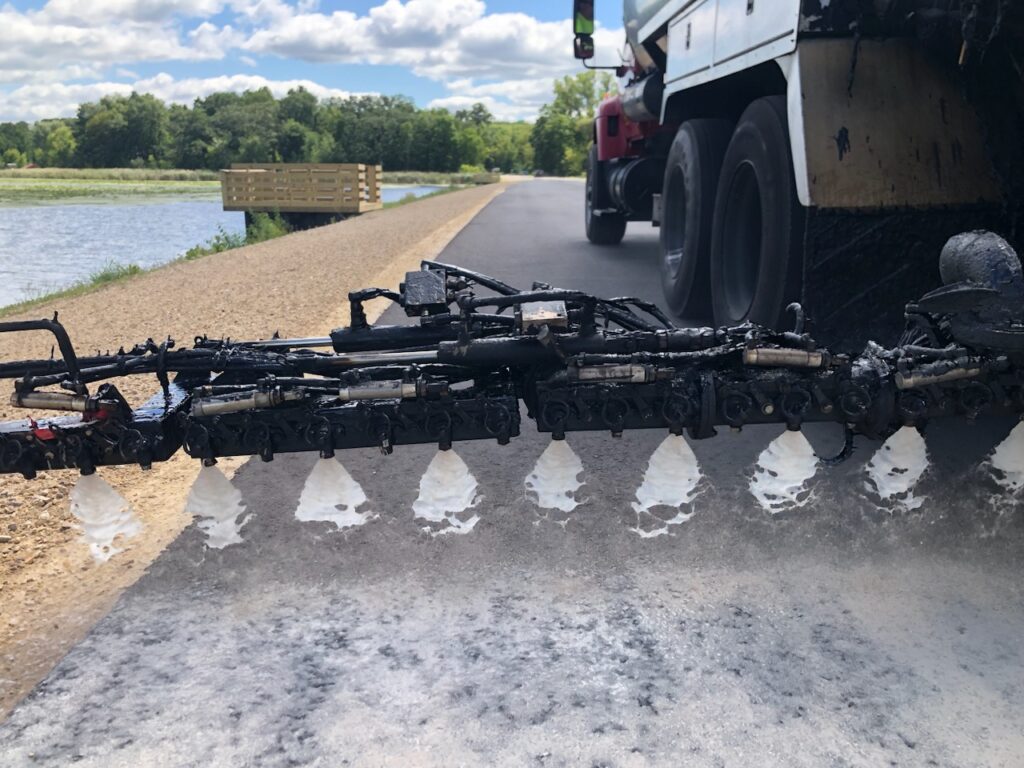
Construction specifications serve as formal, detailed descriptions of the material and workmanship requirements for a project. They’re essentially purchasing contracts between contractors and agencies to ensure that all parties involved understand exactly what materials must be used and how they must perform.
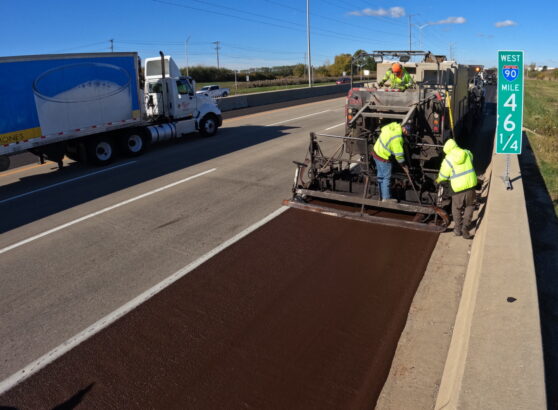
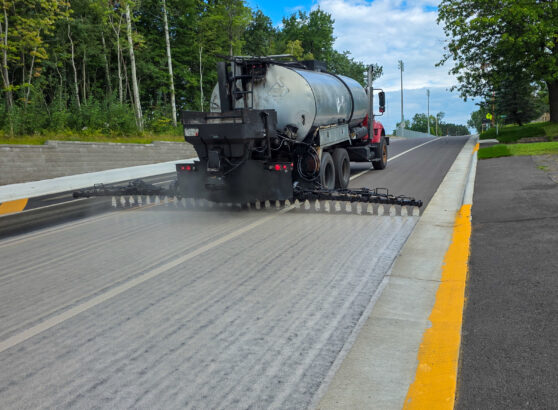
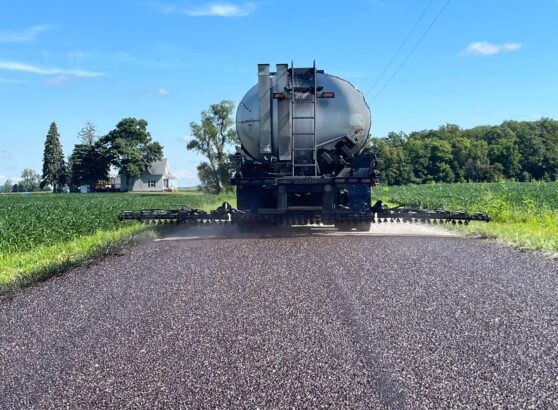
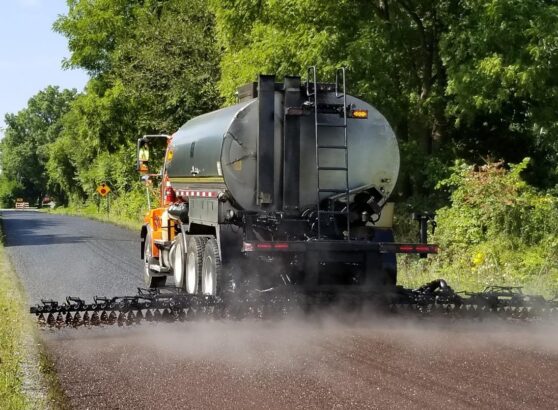
However, key quality control practices are often overlooked in SOR specifications. NRRA research has shown that project variables such as residual application rate of rejuvenator are strongly correlated to SOR performance.3 As such, specifying the application rate, but not checking or verifying during the project, unnecessarily increases risk to both the agency and contractor. Other routine quality control requirements, such as material compliance testing certificates, are also left out of current SOR specifications, reducing their overall reliability and level of trust among agencies.
At a minimum, material compliance certification, onsite application rate verification, daily yield, and any relevant project details that may affect quality should be considered for all SOR projects. A specification that isn’t enforced is as good as no specification at all when troubleshooting subpar quality issues after the project is completed.
Key Takeaways
- Rejuvenators do not reverse aging, but they can mitigate some negative ramifications of asphalt binder aging, leading to better performance.
- Rheology is a more logical and comprehensive evaluation of rejuvenator performance compared to chemistry alone.
- Bio-based vs petroleum is not a performance indicator; what matters is how the material interacts with existing pavement.
- Measuring a single asphalt binder property at a single temperature is insufficient for describing performance.
- Enforcing quality control during application is essential to successful performance.
Asking the Right Questions About Spray-On Rejuvenators
As definitions of success evolve from material inputs to pavement outcomes, rejuvenators can be evaluated more consistently, transparently and with greater confidence in their role as preservation tools. The science of asphalt binder rheology has evolved tremendously over the last 40 years. Why should rejuvenated asphalt be any different?
Here are a few helpful questions to guide productive conversations about rejuvenators to offer information that you need to evaluate a product for your specific pavement needs:
- How does the rejuvenator address binder properties over a range of pavement temperatures and aging conditions?
- What is the application process?
- What does field performance show?
- Based on my pavement conditions, when would you recommend applying a rejuvenator?
Have questions about spray-on asphalt rejuvenators? Our team is happy to meet and discuss rejuvenator performance and efficacy as it pertains to your specific pavement needs. Reach out to us!
Want to learn more about Asphalt Materials’ spray-on asphalt rejuvenator, AMIGUARD™ Rapid Penetrating Emulsion Rejuvenator (RPE-R)? See real-world applications and our product sheet here.
References
- Reinke, G., Baumgardner, G., Hanz, A., & King, S. (2017). Investigation of sterol chemistry to retard the aging of asphalt binders. Transportation Research Record: Journal of the Transportation Research Board, 2633, 127–135.
Available at: https://www.academia.edu/79054442/Investigation_of_Sterol_Chemistry_to_Retard_the_Aging_of_Asphalt_Binders - Guzman, R., Ancheyta, J., Trejo, F., & Rodriguez, S. (2017). Methods for determining asphaltene stability in crude oils. Fuel, 188, 530–543.
Available at: https://www.sciencedirect.com/science/article/abs/pii/S0016236116309590 - Moraes, R. (2025). Spray-on rejuvenators at MnROAD. Asphalt Technology News, 39(2).
Available at: https://www.eng.auburn.edu/research/centers/ncat/research/newsletters/fall2025.pdf - Kutay, E., Islam, T., Vaddy, P., Haider, A. W., & Cetin, B. (2025). Evaluation of proprietary rejuvenators (Report No. MN 2025-39). Minnesota Department of Transportation and Local Road Research Board.
Available at: https://mdl.mndot.gov/items/202539 - Lakes, R. (2009). Viscoelastic materials. Cambridge University Press.
Available at: https://www.cambridge.org/core/books/viscoelastic-materials/0B8FFF3CB84A5CB41670EAC5D19CB61E





































































































Recent Comments